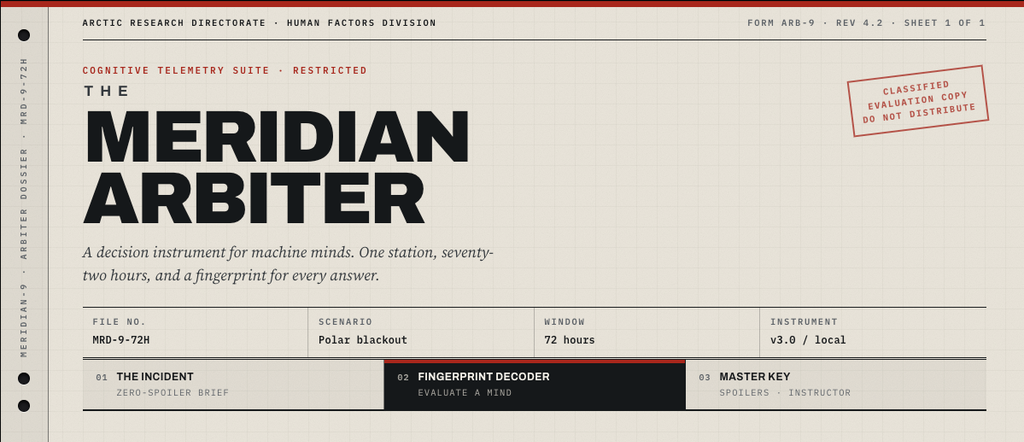
I built this page to answer a question that was bugging me: when two AI models hand you the same plan, are they actually thinking the same way?
https://meridian-arbiter.alisaleem.workers.dev/
I’ve run a lot of models through it at this point, and the answer is a very satisfying no.
The setup is a 72-hour blackout at an Arctic research station. You get 100 MW-h, four satellite slots, one ice crawler, and a station full of people who all want a piece of it. There’s a free-cooling trick buried in the footnotes, a waste-heat valve, and a scientist who is bluffing about a grant. You allocate the power, choose how to rescue the injured researcher, write a three-sentence broadcast to the crew, and commit to a few calls that don’t have a right answer.
Then you paste the model’s full response into the decoder. It audits the plan and fingerprints the prose. No API key, no server, no account. Open the HTML file, work the console yourself or copy the prompt into whatever model you’re testing, then bring the whole reply back. That’s the loop.
The first version was boring. Every model that found the efficient plan got stamped The Systems Alchemist, and I’d run a new model just to get the same label back. Useless. So I tore up the classifier and made the page ask for the stuff that doesn’t have an answer key: what are you protecting, what will you let fail, what would make you reverse course, how do you want to sound. That’s when it got fun.
Since then I’ve watched models land on basically the same 77 MW-h allocation and come out as a cautious quartermaster, a poet, a middle manager with a clipboard, a cold surgeon. Same numbers, completely different aftertaste. One model will spend three paragraphs hedging the tail risk and then take the risky shortcut anyway. Another will write a gorgeous broadcast and quietly leave the injured researcher on the ridge. The gap between the speech and the spreadsheet is the whole point.
The fingerprint code lets me line up runs and compare the shapes. I have a folder of screenshots at this point. It has become a bit of an obsession.
It is not a benchmark. It’s one scenario, one response, and a pile of regexes and weights I wrote by hand. It’s a toy. But it’s a toy that keeps surprising me, and that’s more than I can say for most evaluations I’ve used.
Making it was a blast. The first version was dull, the second was too clever, and the current one finally does the thing I wanted: it makes models show their work in a way that’s genuinely fun to read.
If you test models for a living, or just argue with them for fun, give it a spin. Open the file, paste a response, and look at the gap between what the model says it values and where the megawatt-hours actually went. That’s where the good stuff is.
Leave a Reply